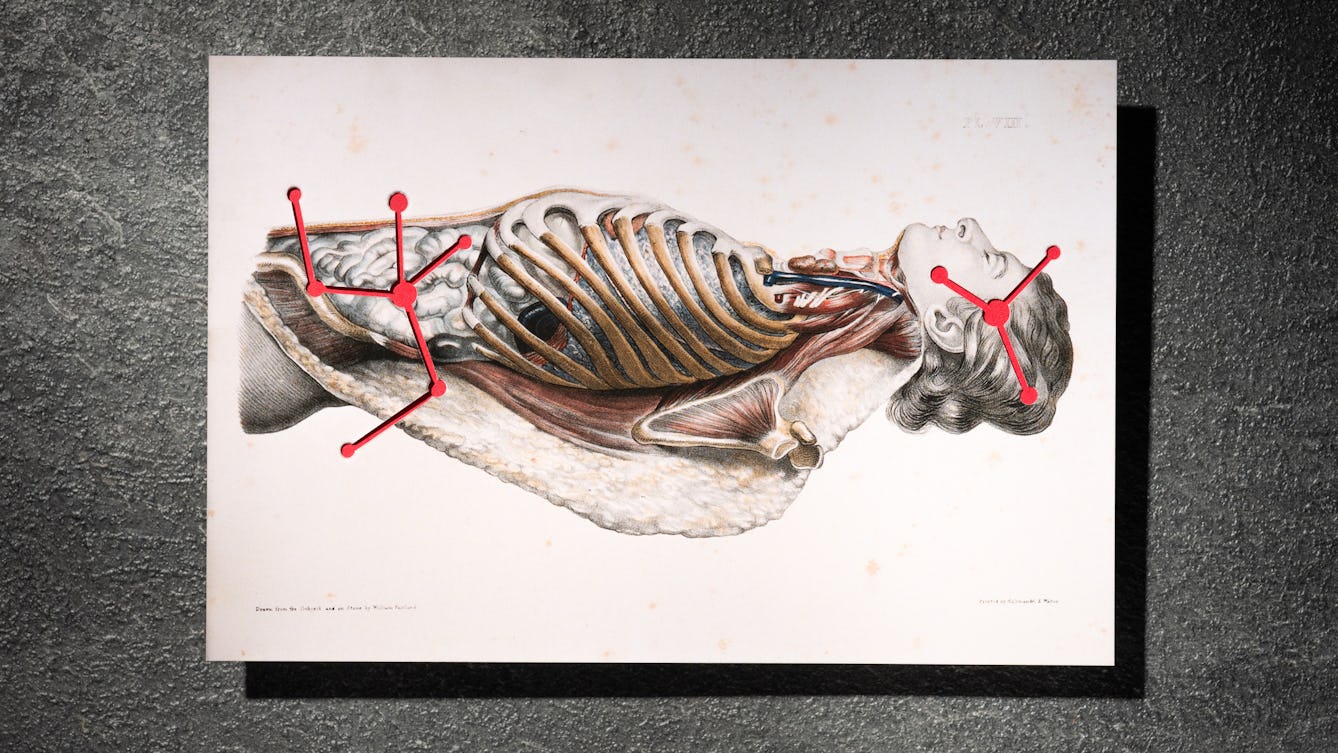
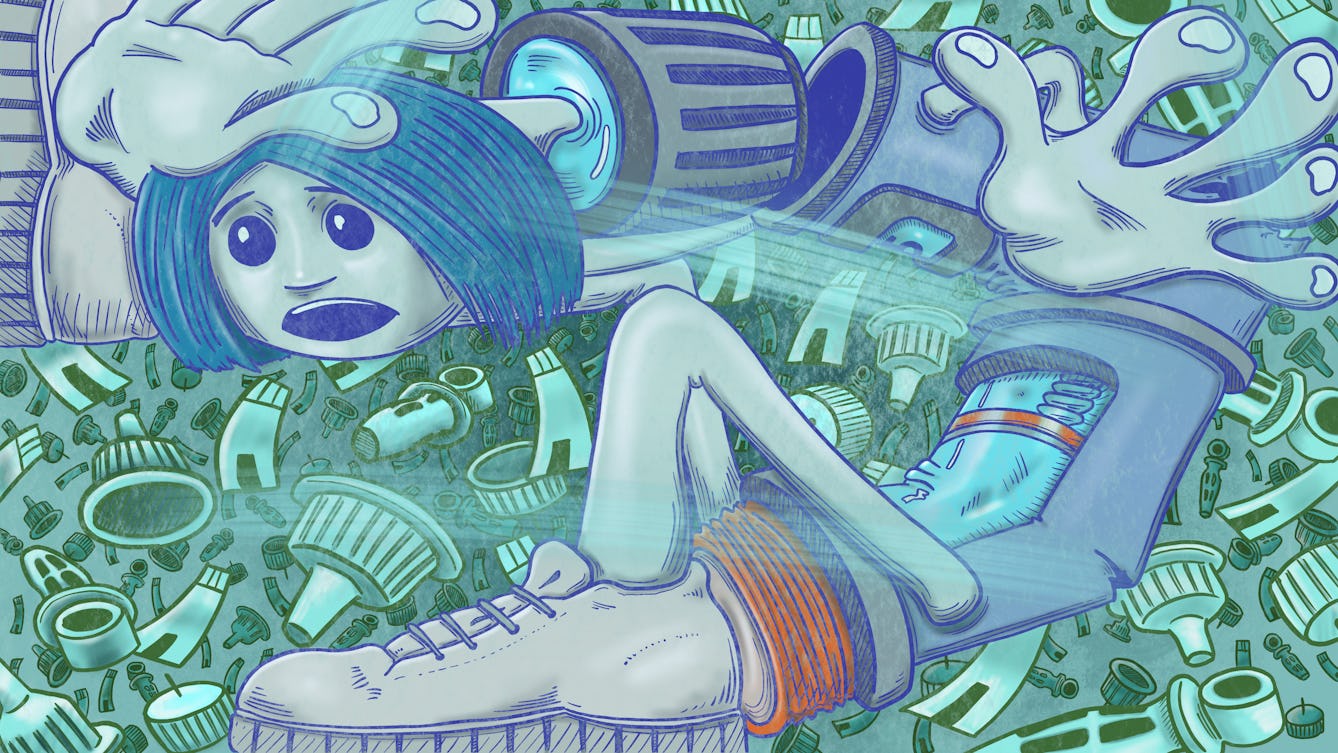
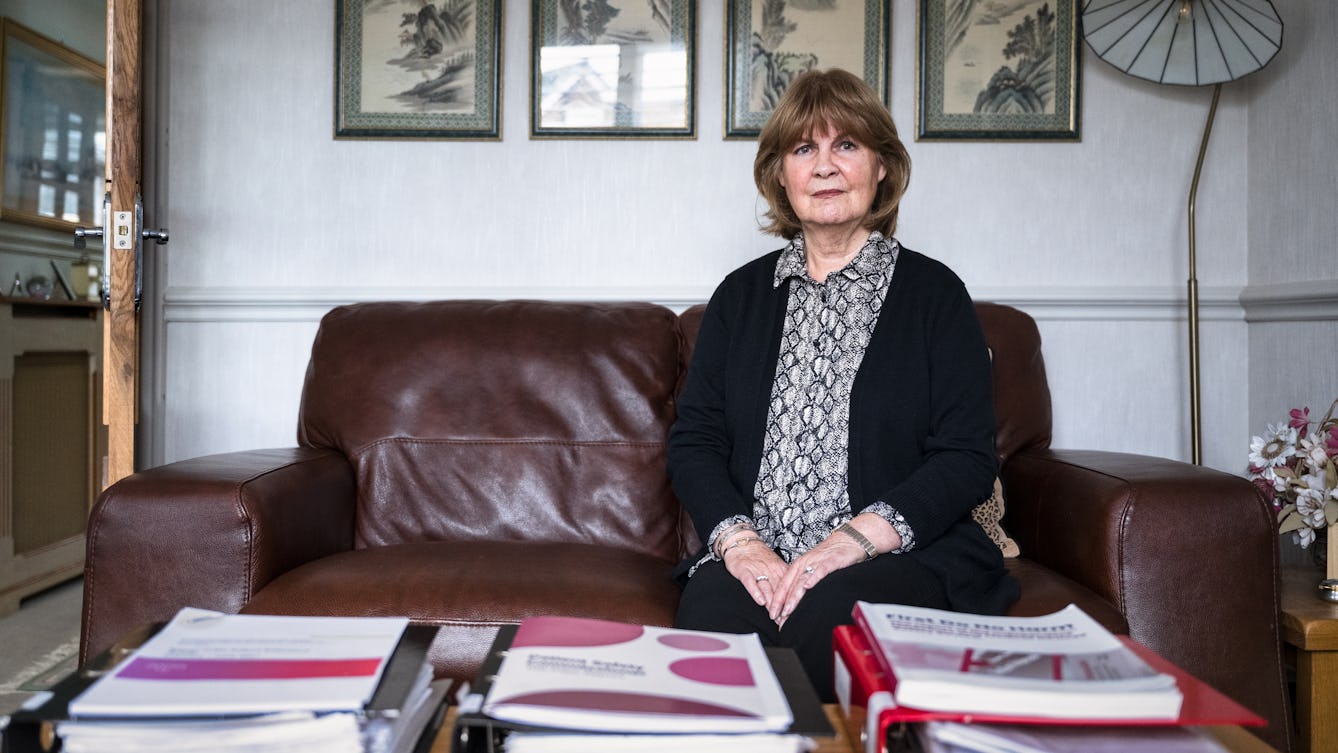
What does it feel like to be wrong? In 2011, neuroscientist Kris De Meyer and filmmaker Sheila Marshall travelled to the USA to meet people who believed the world would end on 21 May. How do we become convinced we’re right – and what does it feel like to have our convictions challenged? Join Kris and Sheila to watch exclusive clips from their documentary Right Between Your Ears, at Wrong! A carnival of human error on Friday 5 July 2013 at Wellcome Collection.
It’s 20 May 2011. We are sitting on a terrace in sunny California, in a small town in the San Francisco Bay Area, having blueberry pancakes (American style) with Simon. He is a friendly and articulate man, a real-estate agent in an upscale part of town with a double university degree in computer science and biochemistry.
A little black bird is nesting in a tree in front of our table. Every time someone passes under the tree, it flies from its nest and, to our great amusement, pecks the person on the back of the head. Even an unsuspecting dog gets a peck. The food is good and the conversation wanders far and wide. It’s a beautiful, relaxing afternoon.
Except it could be our last…
At least, that is the conviction of Simon. We met him at Family Radio, a religious broadcaster in nearby Oakland. Family Radio is at the centre of a campaign to warn the world that 21 May 2011 will be Judgement Day. Like many of the people we met over the past weeks, Simon has wound down his business activities. Why amass more worldly goods if there is no tomorrow? Instead, he focuses on studying the prophecy and getting the word out. Belief in the Judgement Day prophecy comes at an emotional cost: friends and family regard him as crazy for his conviction.
Judgment Day Billboard. Aniku Ltd
When people are locked in personal conflicts and public debates, they may be divided by what they believe, but they share the feeling that they are right and those on the other side are wrong. Simon and his fellow believers would offer a rare insight into why this is. Despite his conviction, he will shortly find out whether his Judgement Day beliefs are right or wrong. Not according to someone else’s standards of the truth, but according to his own.
Psychologists have long been interested in the question of how our convictions form, why they can separate us from other people, and why it can be so difficult to own up to our mistakes. In 1954, social psychologist Leon Festinger and his colleagues joined an end-time prophecy group to observe how people react when they discover their beliefs are wrong. He was driven by his emerging theory of cognitive dissonance. In the following years, dissonance theory was tested and refined in everyday settings. Researchers found that it is especially when our self-image as good, kind, smart and competent people is under threat that dealing with the idea of being wrong becomes so difficult.
Lunch is finished and we get ready to leave. We have to return to Oakland, where we plan to go into the night of the prophecy with a group of believers. Our farewells are cordial. “The real me believes this, but there are other parts of me which are still in doubt,” Simon told us in an interview a few days before. The next day, on 21 May, he will be the first of the believers to call us.
To find out how he and the other believers dealt with being wrong, and what we learned from them, join us on 5 July at Wellcome Collection.
Wrong! is at Wellcome Collection on 5 July. Find out more about Right Between Your Ears and watch the trailer at at rightbetween.com.
Artist Elaine Duigenan is working with young women at New Horizons Youth Centre. She has devised and is running a series of six workshops that explore connections with works in the current Wellcome Collection exhibition, Souzou: Outsider Art from Japan. She’ll be writing a blog each week to relay some of the ideas and outcomes in words and pictures; here’s the third.
In many ways the work of Shota Katsube was the first thing that fired my enthusiasm for the whole ‘Souzou’ exhibition. The ordinariness of the material, the inventiveness and the sheer numbers (like humans, each one unique) were an inspiration. It immediately made me want to handle the material to see what could be done. I sourced an array of twisty ties from the internet, including the metallic colours that Shota uses.
For this workshop, I needed participants to first handle the material and get used to its properties. So we simply wrote our names in joined-up writing, first on paper and then by manipulating the twist ties. Initially this was a challenge, but a kind of concentrated silence came over the group as the twisting and tying got underway. I put a lot of emphasis on the fact that perfection is not required and that there are no rules, just Souzou – imagination and creativity.
I showed them images of Shota’s work, and the girls immediately reached for the ties to make all manner of figures and creatures. This is always the wonderful bit; although the inspiration and directions are the same, everyone goes off on their own meanderings, creating everything from Donnie Darko to spindly giraffes, owls and stars. It was clear from the comments that yet again, this kind of ‘simple play’ was therapeutic and wholly absorbing. There is an element of surprise at the pleasure derived from manipulating the most ordinary of materials and transforming them into something new. ‘E’ commented that it was a bit like taking the top of a champagne bottle and making it into a chair. ‘A’ said she knew someone who made ‘chairs’ out of the labels on bread bags.
The final task was a little more complicated and involved a weaving technique that soon turned into carpets and coasters. ‘A’ commented that we are “losing some of our skills these days, like how to sew on a button. In the past we were made to do it!”
So, again, a very enjoyable time with the group and more lovely creations directly inspired by Shota Katsube and the amazing outsider artists.
Artist Elaine Duigenan is working with young women at New Horizons Youth Centre. She has devised and is running a series of six workshops that explore connections with works in the current Wellcome Collection exhibition, Souzou: Outsider Art from Japan. She’ll be writing a blog each week to relay some of the ideas and outcomes in words and pictures; here’s the second.
Although it was one of the first hot days of the year, we had a good turnout for the second in our series of six workshops.
We started with a very simple task using M.K.’s ‘Lady with Rainbow-Coloured Hair’ as a reference. I asked the girls to draw a portrait of themselves on a piece of paper with line and colour. It was a challenge; admittedly, it is hard, but a surprising number of people are stuck in notions of “I can’t draw” or “I don’t know where to start!” I didn’t want the girls to be afraid of making some marks on a piece of paper. The art displayed in ‘Souzou’ is inspiring for the very reason that it is not afraid of being judged, it is untrammelled and thus so very special.
I encouraged the girls to start with even just one feature, such as an eye, and everyone managed to do something.
We then started to look through a big pile of women’s magazines for a portrait image that stood out (M.K. works with images from adverts and magazines). H said, “Isn’t it amazing how beautiful all of the women are?” and “Where are all the ‘normal’ people?” – again, interesting in the context and illustrative of how narrowly contrived women’s magazines can be.
The rest of the task made reference to a street artist called Bast (Brooklyn based) who makes wonderful layered works which, in part, we sought to emulate. As we cut up individual body parts to make additions to our collaged faces, it felt like we were busting the beauty myth. The work, which had started with one or two airbrushed faces, got increasingly interesting as new and odd parts were glued on. At one point I highlighted the work of artist Hideaki Yoshikawa, who ‘dissects and abstracts the features of the human face’ in his ceramic series Eye, eye, nose, mouth.
A final part of the exercise introduced a further layer by taking another image (and the brown paper instructions from old sewing patterns) and hole punching. When placed over the top, the image underneath is more or less visible. This layering of the seen/unseen pays homage to the ‘Souzou’ artists for their meticularity, detailed focii, self referencing and questioning of the media that surround them.
Over the course of four months, Barry Gibb visited our major overseas programmes in Africa and Asia to make a film about Wellcome Collection’s Art in Global Health project. In the last of his diary entries, Barry describes South Africa.
The last stint of filming for Art in Global Health, all the way to Cape Town, South Africa, proved to be bewildering, amazing and, at times, disconcerting.
For a start, this was an incredibly compressed trip – around 36 hours from touchdown to take off and, on the day of the flight, I’d still not heard anything from the person who was my main interviewee, the artist Zwelethu Mthethwa. Reluctant to leave the house and travel more than 9500km without at least a hint of contact, I called Zwelethu, desperately hoping he would answer.
To my relief, the phone was picked up by a warm sounding man, full of good humour, and we discussed the next day’s plans. At the time, everything sounded so certain.
The 11 hour journey meant I arrived in Cape Town the next morning, with little sleep and just a couple of hours before the adventure with Zwelethu was due to begin. The trip from the airport to the hotel left no doubt I was in a new continent. Table Mountain loomed over us for the entire duration of the trip. Countryside gave way to shanty towns, urban spread and eventually to central Cape Town itself, a beautiful city with a distinct architectural feel.
Several bounced or missed calls later, Zwelethu and I eventually found each other in a frenetically cool café beside the hotel. Tucked away amidst the chic crowd, slurping espresso and sporting a Kangol cap plus long trench coat, Zwelethu felt like a mysterious, coiled spring of energy, intense and energetic. I was very much looking forward to asking him all sorts of questions about his work at the Africa Centre for Health and Population Studies in South Africa’s eastern region of Kwa-Zulu Natal.
Still standing, Zwelethu despatched his strong coffee with a practiced gulp before we exited the café like a stiff breeze, heading to his studio where I hoped we’d do the interview. The area of Cape Town we were in felt like a Parisian version of London’s Camden; hip, fashionable and full of people of every colour as they relaxed or shopped. It became clear this was Zwelethu’s domain, breaking off from our trip to briefly talk to friends, firm up arrangements, and so on. I was quickly building a picture of a man who is fully ‘on’.
In stark contrast to Katie Paterson’s pearl-esque studio in Berlin, Zwelethu briskly welcomed me into his frenetic studio; a living museum of his mind. Canvases were everywhere, piled up or mounted in various states of completion, the walls were covered in ‘notes’ and scribblings and more than anything there were pastels. Small pastels, big pastels, huge pastels like bricks; as if a rainbow had exploded in this room, shattering into these varied pieces of chalk and dust.
From a filmmaking perspective, this was a gift. As I set up the camera for our interview, Zwelethu took me by surprise, stating that he hadn’t been sure he was going to go through with the interview until he’d met me, to see if I was giving off the ‘right kind of energy’. Part of me was mystified – I’d travelled 9500km! However, even in those first few minutes together, I could see how tuned in this artist was to people – how easily he ‘got them’.
Relieved that I was, indeed, emanating the right vibe, we started the interview. Only now did I see how experienced Zwelethu was in front of a camera. There were no nerves, only long thoughtful pauses as he digested each question before unfalteringly providing a wonderfully articulate and insightful response. I should have known this would be the case in advance, after all, this man is one of the most prominent artists in South Africa.
Zwelethu allowed me to film various aspects of his studio. Naturally, a range of charcoal shots made it in but he also took great pleasure in showing me a very bizarre piece of furniture: a dresser filled with human hair. I was so struck by the oddness that I completely missed the intent of this particular piece of art, but there was something lyrical about this one specific component of a multitude of humans being hoarded into a drawer.
I’d explained to Zwelethu that during my other trips abroad it had been useful, if possible, to capture a sense of the place we were filming, largely to help create visually and culturally distinct locations for the film being made about the project. He thought for a long moment then smiled as he stormed away, ‘Let’s go, I have something special to show you.’
Even as we drove, Zwelethu wouldn’t tell me where we were going. His preferred weapon of choice is a beautiful, large format digital camera; at least when taking composed shots. But for general research whilst driving or walking around, he uses a cheap, plastic disposable camera. Riding along with Zwelethu amounts to lively conversation punctuated with the occasional ‘click and ratchet’ of his research tool as he captures another images to feed his imagination and wind on the film for the next shot.
At last I saw where he was taking me, the local township, or shanty town. As a London dweller, the sight of a full-scale township is so incompatible with my worldview, that it took a good while for it to sink in. A sea of thousands upon thousands of multi-coloured dwellings, none higher than one story tall, none larger than a decent sized shed. All of them made of a potpourri of basic materials, corrugated metal, wood, brick.
Just like Zwlelethu’s studio, the township was peppered with bright primary colours; attempts to add individuality, some vague uniqueness to the habitats in this monolayer of life so powerfully symbolic of the aftermath of years of oppression.
As we drove slowly through the streets, Zwelethu explained the history and meaning of the township (“click, ratchet”), that the people here are, by and large, content (“click, ratchet”), that he feels safe here and crime is low. He explained that, if someone from the township appears one day wearing designer trainers or underwear, they are not targeted for theft (“click, ratchet”). Instead, they are celebrated as a symbol of what is possible, that anyone can ‘make it’ in this new South Africa.
Spontaneously, Zwelethu decided he wanted to locate an illicit, unlicensed, bar he’d heard about from a friend, so off we drove. Past people, goats and dogs roaming the streets, savouring the smells of street markets and barbeques selling cooked meat. And everywhere, the ubiquitous sign for a brand of fizzy drink so popular I can’t bring myself to write it down.
When we did find the bar, it was not what I expected. Externally, it looked near identical to all the other loosely fabricated dwellings, if a little bigger. Inside however, the owner had taken pains to make this a decent, club-like environment. Sure, it was small, but there was a bar, soft seating, good lighting and a DJ. Expensive champagne, whiskey and a range of other spirits occupied the bar. Zwelethu, in a display of generosity bought an entire bottle of whisky for us and the owners to share. Clearly, he knew the team running this place and it was made abundantly clear to me that, even if I left my camera equipment sitting at the door of the bar, absolutely no one would take it – not whilst I was under the owner’s protection. Just one small insight into a layer of life I’d never have seen without Zwelethu’s guidance.
As I cautiously sipped away at my dram, we were brought some much needed nutrition on the house, a barbequed goat’s neck. Having eaten nothing all day, I attacked the neck with gusto, much to delight of my companions. In hindsight, my only faux pas was to avoid the fat – a lesson learnt a little too late as I watched them eat slabs of cooked adipose tissue with glee.
Turning a unique experience into a surreal one, a beautiful girl then glided into the bar who, it turned out, was a local music star. Carrying her album with her, she was going around the township, selling this album, symbolic of far more than musical creation. The owners insisted we have a photograph taken together, which is how I ended up with a photograph of myself looking baffled and confused, standing alongside this diminutive South African pop star.
As the night drew on and the bottle’s contents surrendered to good company, it was time for Zwelethu and myself to leave, waving goodbye to our new friends and one of the most special evenings of my life. Zwelethu wished to give me some of his actual photos for the film and insisted on driving me back to his apartment to burn them onto a DVD. Slightly confused, I asked him why he couldn’t just email them to me (they were digital, after all). His answer: “We started this journey together, we must finish this journey together”.
Barry J Gibb
Barry J Gibb is a Science Multimedia Producer at the Wellcome Trust.
Advertisement for Burroughs Wellcome showing various situations in which a Tabloid medicine chest would be useful. Wellcome Images
This year is the 101st anniversary of the death of the Antarctic explorer, Captain Robert Falcon Scott. To mark this occasion Suzanne Paterson considers a small but not unimportant item carried by Scott on the 1910 British Antarctic Expedition.
Henry Wellcome was a man of many talents. He was inspiring, innovative and most of all incredibly aware of the importance of good marketing. He astutely recognised that good publicity would enhance the reputation of Burroughs Wellcome & Co. products and thus maximise profits. He was a keen social networker: what he lacked in Pinterest, Twitter and Facebook accounts, he made up for by throwing lavish parties and by courting the glitterati of contemporary English society. Oscar Wilde, Joseph Lister and Henry Morton Stanley were all part of his sparkling social circle and he took full advantage of this. Using his social connections, Henry was quick to employ the practice of celebrity endorsement, but stand aside Cheryl Cole and Beyoncé, for it was eminent explorers, and not popular recording artists, that were the cream of Henry’s crop. Henry gave Burroughs Wellcome & Co. medicine chests to the likes of Henry Morton Stanley, Ernest Shackleton and to Hugh Ruttledge’s 1933 expedition to scale Mount Everest, all completely free of charge. Even President Theodore Roosevelt Jr. was a beneficiary of Henry’s not entirely altruistic generosity. Nonetheless, explorers were quick to endorse Wellcome’s products as they were filled with Burroughs Wellcome & Co.’s patented ‘Tabloid’ medicines that were particularly suited to the explorers’ needs. The medicine chests were compact, lightweight and efficient so it is little wonder that they made their way across the globe.
There is, however, one particularly fascinating medicine chest, which is this month’s object of the month. It is the medicine chest given to Captain Robert Falcon Scott as part of the supplies for the 1910 British Antarctic Expedition.
A Burroughs Wellcome & Co. medicine chest used on the British Antarctic Expedition,. Wellcome Images
Led by Captain Scott aboard the Dundee whaler the Terra Nova, the British Antarctic Expedition had multiple aims. The crew hoped to carry out extensive exploration and scientific experiments including biology, geology, glaciology, meteorology, and geophysics along the coast of Victoria Land on the Ross Ice Shelf. In addition, the expedition also aimed to be the first to reach the geographical South Pole. Having arrived in Antarctica, Scott and four crew members set out to take the pole, but they were beaten by the Norwegian team, headed by Roald Amundsen, by a mere 33 days. Tragically, Scott and his party died on their return journey to base camp, just 11 miles from their next food depot. When their bodies were discovered eight months later, beside them were two Burroughs Wellcome & Co. medicine chests.
The medicine chests were a veritable pharmacopoeia; they contained cascara sagrada, a mild laxative; ipecacuanha powder for gastric irritation; Dover’s powder, ipecacuanha with opium for pain relief; and quinine, used to treat malaria. Scott, however, was prepared to use the medicines for a purpose for which they were not originally intended. Knowing that the party were unlikely to survive their ordeal, Scott ordered Edward Wilson, the expedition’s Chief Scientist and a qualified doctor, to divide the painkillers between them so they could each end their life on their own terms. Writing in his diary on the 11th March 1912, Scott states, “I practically ordered Wilson to hand over the means of ending our troubles to us, so that anyone of us may know how to do so.” After ransacking the medicine chests Scott, Bowers and Oates had thirty opium tabloids apiece and Wilson, the morphine. It seems, however, that Scott had a change of heart. He wrote on either 22nd or 23rd March: “no fuel and only one or two left of food – must be near the end. Have decided that it shall be natural – we shall march for the depot with our without our effects and die in our tracks.”
Tabloid medicine chest issued to the Scott Polar Expedition, found with their bodies. Wellcome Images.
This medicine chest also provides a fascinating insight into Henry’s devotion to the marketing of his products. In their marketing literature Burroughs Wellcome & Co. claimed ‘First at the North Pole and First at the South Pole’. That’s right, a Burroughs Wellcome & Co. medicine chest was part of the first successful venture to the geographical South Pole, only it belonged to Amundsen and not Scott. Securing the South Pole would have been a great achievement for the British Empire and although my research is yet to uncover whether Henry donated a medicine chest to the Norwegian’s rival effort, if he did then this suggests that despite having become a British subject, Henry’s loyalty lay with his company and not with the honour of his now adopted nation. A true businessman to the core.
Scott’s medicine chest, which is on display in Wellcome Collection’s permanent gallery, Medicine Man, is quietly unassuming. It is not flashy and it does not instantly catch your eye but this small, grubby, canvas-covered box has made the epic journey to Antarctica and back again – something that most of us can only dream of. Indeed, Scott’s medicine chest also reminds us of the fickle nature of the Antarctic continent and the sheer magnitude of Scott’s achievement, however tragic. If Sir Ranulph Fiennes supported by modern technology and the best healthcare had to withdraw from his recent attempt to cross the South Pole during the Antarctic winter, then it is all the more remarkable that Scott’s party, armed only with basic provisions and two of these medicine chests, made it as far as they did.
Suzanne Paterson is a Visitor Services Assistant at Wellcome Collection.
Over the course of four months, Barry Gibb visited our major overseas programmes in Africa and Asia to make a film about Wellcome Collection’s Art in Global Health project. In the latest of his diary entries, Barry makes a brief stop somewhere a little closer to home: Berlin.
As a researcher back in the early 90s, I spent several months living and working in Berlin, Germany, doing a spot of ad-hoc science at the Max-Planck-Institute for Molecular Genetics. I remember buses that ran like clockwork, the intense cold and Tacheles, a huge department store that had become a squat and home to some of the most amazing art and raves.
Back at Tegel Airport, memories began fighting their way through the treacle of time as I made my way to meet Katie Paterson, the artist-in-residence at the Wellcome Trust Sanger Institute in the UK (who, before you ask, lives in Germany – hence my being here and not back home!).
Arriving at Katie’s place, she and her partner immediately welcomed me into the space in which Katie thinks and creates; a cubic, entirely white room. Whilst often filled with materials and objects of inspiration (offering clues to Katie’s cerebral interests), today the contents of this room were minimal – perfect for our interview.
Despite the studio being right beside a main road, we were a few storeys up – far enough away from the traffic to stop noise being too much of an issue. And, thanks to large windows all across this street facing wall, I was able to place Katie looking directly into a flood of natural light, making the most of a sunny day and her unusually bright, blue eyes.
The interview itself was an opportunity to gather material for the film but also to gain a deeper insight into how Katie sees the world. As it turns out, she is interested in nothingness, the absence of things: space and time. Within the context of her apartment, beyond the studio, this manifests itself in meteorite fragments and rocks of varying texture, a physical map of the moon, books about space. At the Sanger Institute, her discussions with scientists led her down a path of inquiry into the genetic heritage of humanity; where did the first humans emerge, how did they spread across the planet?
In Katie’s own words, “I believe work being undertaken in genome sequencing at the Sanger Institute can allow us to penetrate questions of existence: contemplate who we are, where we have come from and how we relate to one another, and enable us to be part of a complex decision-making process about the possible direction of our species.”
After the interview, with a deeper respect for Katie and her work, there followed a filming challenge – how do you show the internal creative processes of a person who, when not busy creating their works, spends her increasingly rare moments of tranquility deep in thought, formulating ideas? Shots of Katie simply staring into space seemed a little hackneyed so, fortunately, Katie shared that she keeps written notes, notes she was prepared to add to. Bingo.
There are so many nuances of human behavior, even within the simplest of actions, that I now knew we’d have enough coverage of Katie ‘thinking’. Wide and mid shots, macro shots, the pencil moving across the page, the eyes as they pause and consider. Finally, Katie introduced me to their two new kittens, fragile lumps of fluff with legs. These had nothing to do with DNA and human heritage but everything to do with fun and the promise of moments of levity between those deeper thoughts.
The next morning came all too quickly. Leaving for the airport at 4am, time suddenly felt very present. I was about to travel across countries and time zones, flying beneath stars that still filled the dark sky, bathing the planet in light from millions of years in the past. This sudden, profound awareness of space and time, I have called, the Paterson Effect.
Barry J Gibb
Barry J Gibb is a Science Multimedia Producer at the Wellcome Trust.
Ladybirds: good for pest control, or pests themselves? As our Who’s the Pest? season draws to a close, Emma Rhule takes a closer look at our relationship with these tiny flying beetles.
Bright, colourful and hearty eaters of aphids (the sticky little flies that infest everything from cabbages to roses), ladybirds have long been the gardener’s friend. Gardeners and farmers will go to great lengths to encourage more ladybirds onto their patch. One way you can entice ladybirds into your garden is to plant wildflowers – they are particularly fond of marigold and nettles. And, if all else fails, the eggs and larvae can be bought online.
There is a long history of introducing exotic ladybirds to help control agricultural pests. The Vedalia ladybird, Rodolia cardinalis, which was originally from Australia, is credited with saving the Californian citrus industry in the late 1880s. It was the start of the biological control industry that controls pest species using other organisms.
Following in this tradition, the harlequin ladybird, Harmonia axyridis, was released across the USA and Europe to help combat aphid infestations. Originally from Asia, the voracious appetite of this beetle makes it an extremely successful control agent. A single adult can eat more than 200 aphids a day, and a developing larva can consume upwards of 1000 aphids. Their use allows farmers to reduce the amount of insecticides they need on their crops which should, in turn, allow other beneficial insects to flourish.
The very hungry ladybird
Unfortunately, the harlequin’s insatiable appetite is not limited to aphids: the larvae are particularly indiscriminate. They will eat almost anything they encounter – including other aphid eaters such as hoverflies and lacewings, as well as caterpillars. They will also eat the eggs and larvae of other ladybirds, and their cannibalistic tendencies even extend to their own siblings. To make matters worse, there is little that eats the harlequin. Like our native ladybirds, their bright colours advertise the toxins present in their blood. These chemicals make ladybirds taste foul and can be deadly to imprudent would-be predators.
In 2004, the first British harlequin was spotted in the car park of a country pub in Essex called The White Lion. Never intentionally introduced, researchers suspect the early arrivals that reached the UK were a combination of hardy pioneers flying across the Channel and sneaky stowaways in imported goods. Since then, they have spread across the UK and been reported as far north as the Shetland Islands.
Since arriving, the harlequin’s wide-ranging diet has had serious implications for British ladybirds. The once familiar two-spot ladybird has been particularly hard hit, losing out to the larger, hungrier competitor with which it now shares its habitat. The wider ecosystem is affected, too – particularly the predators, parasites and pathogens that rely on these native species for their own existence.
And humans do not escape unscathed. Over the past few years, come October and November, you may have seen harlequins in your house. In the winter, our native species mostly hibernate outside in dead leaves or in the crevices of tree trunks, sheltered from the cold and rain. In their native Asia, harlequins normally use rocks and cliffs. In the relatively flat UK, houses must seem like a good alternative. Once the central heating comes on, though, the beetles warm up and start flying around. They may be hungry and take a nibble. A little nip is usually not a problem, but some people can experience an allergic reaction. If they are feeling threatened, the natural response of all ladybirds is to leak a small amount of foul-smelling yellow blood from their knees, which can stain curtains and sofas.
Fighting back
So what can we do? It would be impossible to capture and kill all the harlequin ladybirds in the country. In fact, the Harlequin Ladybird Survey, which has been monitoring the spread of the ladybird since its arrival, strongly discourages this because there is a real risk of misidentification. The harlequin was the focus of my PhD research: one of my jobs involved opening letters containing live ladybirds, sent to us by members of the public for identification. These days, photos can be uploaded with records of sightings allowing researchers to verify exactly which species has been found, saving us from climbing onto tables to recapture escapee beetles crawling across the ceiling.
When the harlequin was taken from its native environment, researchers made sure that any released into the wild were free of parasites. As such, many of the natural checks and balances that would have kept the numbers of individuals under control were removed. Nothing in the new environment would have been immediately able to fill the gap, allowing populations to flourish. One hope is that the parasites and pathogens that exploit our native ladybirds will start to adapt to the newcomer. Nearly ten years on, there is some evidence that this is starting to happen.
But how long can we wait when the problems are already apparent? My research looked at whether a sexually transmitted parasite found on European ladybirds, including the harlequin, could help. The blood-sucking parasite can be thought of as a form of ladybird birth control. When females are infected with adult parasites, they still lay eggs, but these do not hatch – the ladybird is effectively sterile. If the parasites die, within a couple of days any eggs laid will hatch. Of course, I am aware of the irony of my work – could we, and should we, introduce yet another species to help control an exotic beetle that was itself introduced to fight an insect pest? Could the parasite become the next problem in town?
After five years, I came to the conclusion that we still didn’t know enough to justify taking that risk. Increasingly aware of what can go wrong when we tinker with ecosystems, we are much more cautious than we used to be, and rightly so. From grey squirrels to cane toads, knotweed to ladybirds, there are lots of examples of the unintended side-effects of our actions. So, who is really the pest? Those species that arrive in a new place and wreak havoc, or the species that put them there?
Emma Rhule is a graduate trainee at the Wellcome Trust. Play our Who’s the Pest game online.
Wellcome Collection is a free visitor destination for the incurably curious, exploring the connections between medicine, life and art in the past, present and future. You can find out more about us on the Wellcome Collection website. Find out more about this blog.